



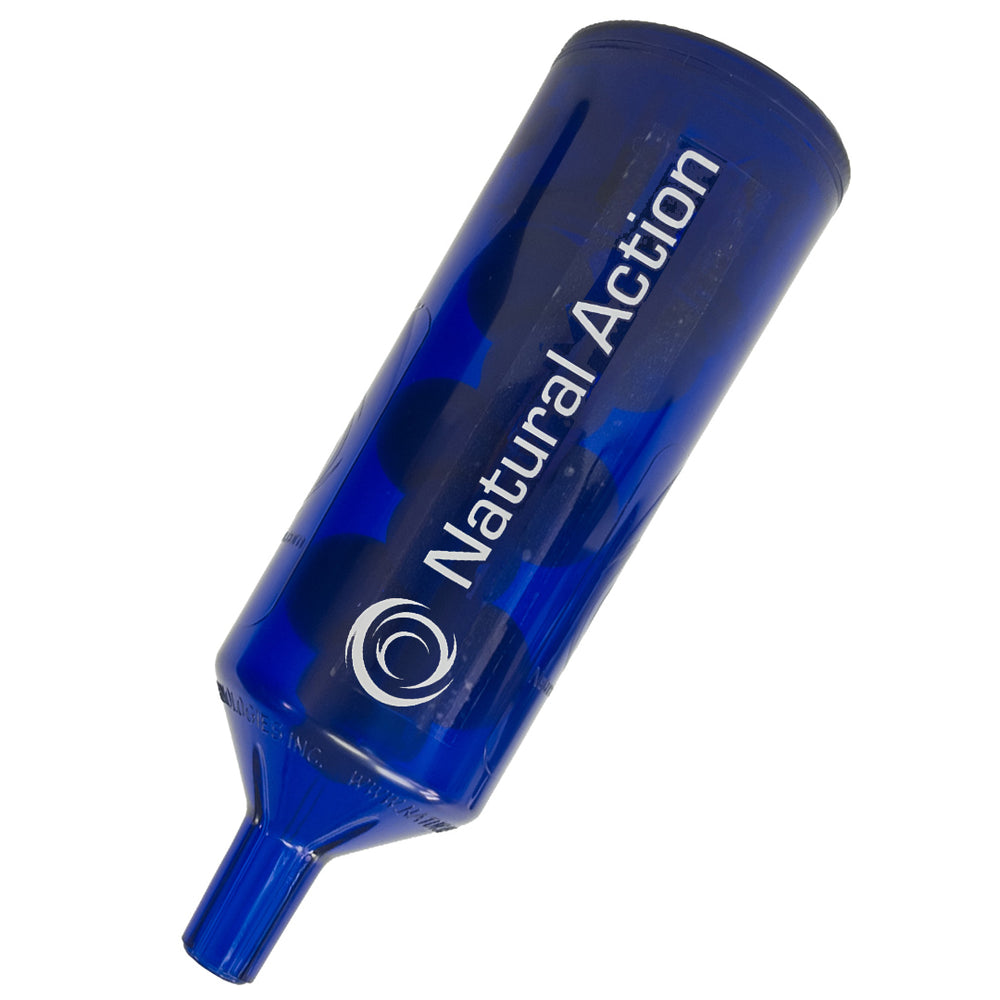
THE SCIENCE BEHIND THE SINK REVITALIZER
Filtration, Flow, and the Way Water Should Work
Clean water is important.
But how water behaves matters too.
Most under-sink systems focus on one goal:
Removing contaminants.
And that matters.
But there is another layer—often overlooked:
how water moves
and how it interacts with you.
The Sink Revitalizer is designed to address both:
- Water quality (filtration)
- Water behavior (flow dynamics)

What Happens to Water in Your Home
Before water reaches your kitchen sink, it travels through:
- Treatment plants
- Pressurized systems
- Long, straight pipes
- Chemically controlled environments
By the time it reaches your faucet, water is typically:
- Linear in flow
- Pressurized and uniform
- Disconnected from natural movement patterns
From a fluid dynamics perspective, this results in laminar-dominant flow, where mixing, aeration, and interaction are reduced (Munson et al., 2013).
Efficient—
but not how water behaves in nature.
How Water Behaves in Nature
In natural environments, water is constantly in motion.
It:
- Swirls
- Spirals
- Interacts with minerals and surfaces
- Moves in dynamic, changing patterns
This movement creates vortex flow—a well-studied phenomenon in fluid mechanics.
Vortex and turbulent flow are associated with:
- Increased mixing and mass transfer
- Enhanced oxygen exchange
- Greater interaction with surrounding environments
(Nezu & Nakagawa, 1993; Wilcox, 2006)
This is how water maintains dynamic behavior in rivers, rainfall, and springs.
The Sink Revitalizer is designed to reintroduce this type of motion.
A Two-Part System: Filtration + Flow
The Sink Revitalizer combines two complementary processes:
1. Filtration (Optional Add-On)
Depending on your setup, you can pair the system with:
🔹 Multipure (Carbon Filtration)
- Reduces chlorine, contaminants, taste, and odor
- Retains beneficial minerals
🔹 Reverse Osmosis (RO)
- Multi-stage filtration
- Removes dissolved solids and a broader range of impurities
These systems focus on:
what’s in your water
2. Vortex Flow Structuring
After filtration—or directly from your tap—water flows through the revitalizer.
Inside, water is guided through:
- Engineered internal geometry
- Spiral (vortex) pathways
- Controlled flow environments
This creates:
- Rotational motion
- Micro-turbulence
- Continuous internal interaction
From a physics standpoint, turbulence increases mass transfer efficiency and fluid interaction (Wilcox, 2006).
This stage focuses on:
how your water behaves
How the System Works
- Water enters from your plumbing
- (Optional) Filtration removes unwanted substances
- Water passes through vortex pathways
- Water exits in a more dynamic state
This happens:
- Instantly
- Continuously
- Without additives
What Is “Structured Water”?
Structured water refers to water influenced by:
- Movement
- Surface interaction
- Environmental conditions
Water molecules form dynamic hydrogen-bond networks that shift based on energy and motion (Ball, 2008 — https://doi.org/10.1021/cr068037a).
Research into interfacial water shows that near surfaces, water can exhibit:
- More ordered molecular arrangements
- Distinct physical properties
- Altered charge behavior
(Zheng et al., 2006 — https://doi.org/10.1016/j.colsurfb.2005.08.027)
This suggests that how water moves and interacts affects how it organizes itself.
In nature, this occurs through:
- Flow
- Contact with minerals
- Continuous movement
The Sink Revitalizer is designed to recreate aspects of these conditions—passively.
The Role of Flow Dynamics
The core principle behind the system is fluid dynamics.
Vortex Motion
Water is guided into rotational flow patterns that:
- Increase mixing
- Redistribute energy
- Promote internal interaction
These patterns are naturally present in rivers and streams.
Engineered Flow Pathways
Inside the device, water moves through:
- Precision-designed channels
- Controlled geometries
- Interaction surfaces
This creates:
- Organized turbulence
- Continuous motion
- Balanced flow behavior
In fluid systems, turbulence enhances transport processes and interaction efficiency (Nezu & Nakagawa, 1993).
What This Means at Your Sink
While the process is physical and internal, many users report:
- Smoother-tasting water
- Cleaner rinsing of produce and dishes
- Less “flat” or harsh feel
- More consistent water experience
These effects are not due to added substances—
but to changes in flow and interaction.
Filtration vs. Flow
Most systems focus on one dimension:
| Approach | Focus |
|---|---|
| Filtration | Removes contaminants |
| Flow Structuring | Changes behavior |
The Sink Revitalizer combines both:
- Clean water (when filtration is used)
- Improved water behavior
Simple by Design
The system operates:
- Without electricity
- Without chemicals
- Without moving parts
- Without ongoing maintenance
It uses existing water pressure and internal design alone.
Important Clarifications
Does it replace filtration?
No. Filtration and flow structuring serve different roles.
Does it add anything to the water?
No. The process is entirely physical.
Does it remove contaminants?
Only if paired with filtration (Multipure or RO).
Is this a medical device?
No. It is designed to influence water behavior—not treat or diagnose health conditions.
The Big Idea
Most systems focus on cleaning water.
Very few focus on how water works.
The Sink Revitalizer bridges that gap.
Final Thought
Water isn’t just something you drink.
It’s something you interact with—every day.
When you improve it at the point of use, you improve:
- Drinking
- Cooking
- Washing
- Daily routines
Your water. Your sink. Your experience.
References
- Ball, P. (2008). Water as an active constituent in cell biology.
https://doi.org/10.1021/cr068037a - Zheng, J. M., et al. (2006). Interfacial water structure.
https://doi.org/10.1016/j.colsurfb.2005.08.027
- Nezu, I., & Nakagawa, H. (1993). Turbulence in Open-Channel Flows.
- Wilcox, D. C. (2006). Turbulence Modeling for CFD.
- Munson, B. R., et al. (2013). Fundamentals of Fluid Mechanics.