



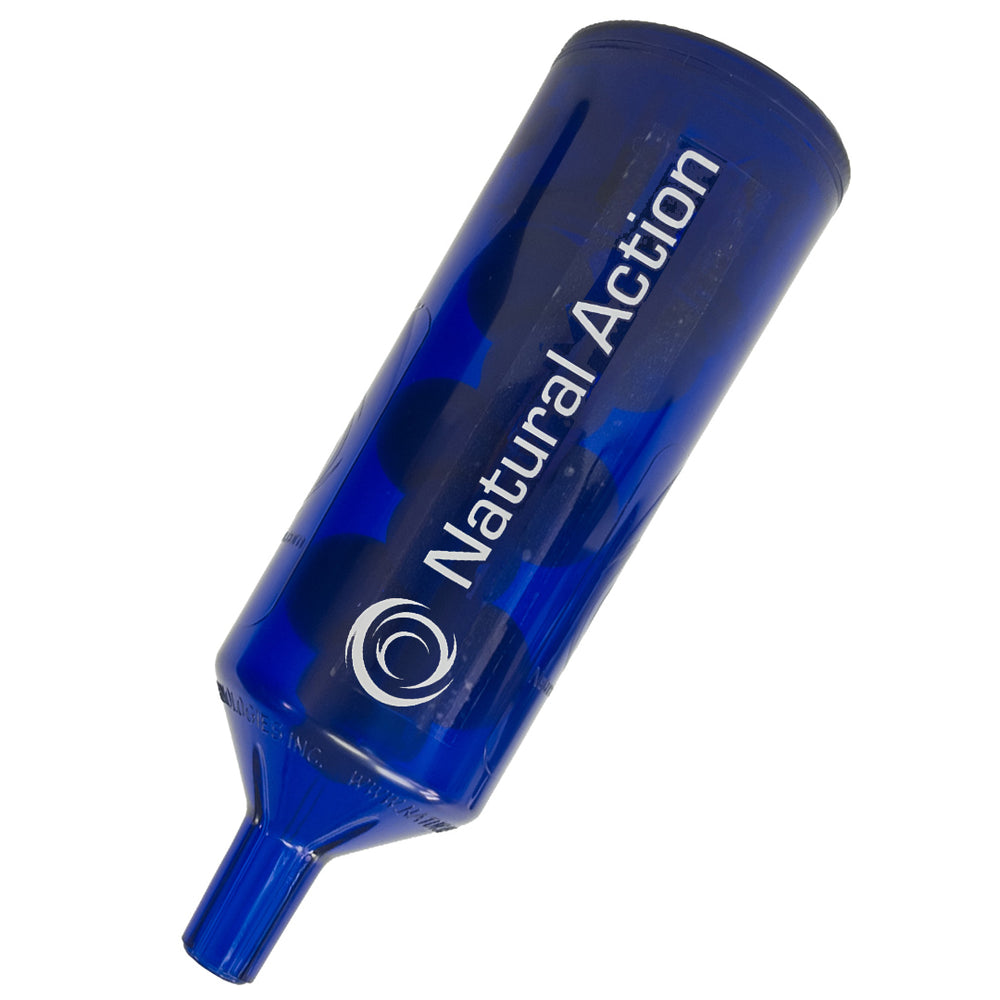
THE SCIENCE BEHIND THE SHOWER STRUCTURED WATER REVITALIZER
A More Natural Way for Water to Move
Water is more than a simple chemical formula. Its behavior is influenced by motion, pressure, temperature, surrounding surfaces, and the path it follows.
Before reaching your shower, water typically travels through treatment facilities, storage systems, pumps, and miles of straight, pressurized plumbing. This journey is very different from the way water moves through streams, rivers, waterfalls, and natural springs.
The Natural Action Shower Structured Water Revitalizer is designed to reintroduce dynamic, vortex-inspired movement at the final stage—just before the water reaches your showerhead.
It does not add chemicals, use electricity, or require replacement filters. Instead, it uses internal flow geometry and the existing water pressure in your home to change the physical pathway of the water.
At a Glance
- Installs in approximately five minutes
- Fits standard residential shower connections
- Uses existing household water pressure
- Requires no electricity
- Contains no replacement cartridges
- Requires no routine maintenance
- Made in the USA
- Includes a 10 year limited warranty
- Covered by a 90 day satisfaction guarantee
Shop the Shower Structured Water Revitalizer
Why the Movement of Water Matters
Water does not always behave the same way.
Its movement can change depending on:
- The shape of its pathway
- Water pressure
- Flow velocity
- Surface contact
- Temperature
- Turbulence
- Vortex formation
These principles are part of fluid dynamics, the established scientific study of how liquids and gases move.
When water travels through a straight pipe, the pipe restricts the direction in which it can move. Depending on the flow rate and plumbing conditions, the movement may be relatively uniform or may contain varying degrees of turbulence.
In nature, water follows a much more complex path. It bends around rocks, falls through the air, forms spirals, changes direction, and interacts continuously with surrounding surfaces.
The Shower Structured Water Revitalizer is designed to create a more dynamic flow environment immediately before the water enters your shower.
How the Shower Structured Water Revitalizer Works
It does not chemically change the water.
It focuses on physical flow transformation.
1. Water Enters the Device
Water flows from the shower arm into the Shower Structured Water Revitalizer using the existing pressure in your plumbing system.
2. Internal Geometry Changes the Flow Path
The internal design encourages water to move through a rotational, nonlinear pathway rather than continuing through a simple straight section of pipe.
3. Vortex-Inspired Movement Develops
The water experiences changes in direction, velocity, pressure, and surface contact as it travels through the device.
4. Water Flows into Your Showerhead
The revitalized flow then enters your existing showerhead and is distributed across the body.
The Science of Vortex Flow
A vortex is a rotating region within a fluid.
Vortices appear throughout nature, including:
- Rivers
- Streams
- Ocean currents
- Waterfalls
- Whirlpools
- Weather systems
In fluid mechanics, vortex motion is known to redistribute momentum and energy throughout a fluid. It can also influence mixing, pressure, velocity, and interaction with surrounding surfaces.
The Shower Structured Water Revitalizer uses internal geometry designed to encourage this type of rotational movement.
This does not mean that the device changes the chemical formula of water. The water remains H₂O. The change occurs in the way the water moves through the device.
Water in Nature Compared with Water in Plumbing
| Water in Natural Environments | Water in Modern Plumbing |
|---|---|
| Changes direction continuously | Primarily follows straight pipes |
| Forms spirals, eddies, and vortices | Movement is mechanically constrained |
| Interacts with rocks, minerals, and air | Has limited environmental interaction |
| Experiences changing pressure and velocity | Remains under controlled pressure |
| Moves through varied surfaces and pathways | Moves through standardized plumbing |
The Shower Structured Water Revitalizer does not attempt to recreate an entire natural water system. It is designed to reintroduce certain aspects of movement, surface interaction, and flow complexity at the shower.
Fluid Dynamics: The Strongest Scientific Foundation
The most established science related to the Shower Structured Water Revitalizer is fluid dynamics.
Fluid dynamics demonstrates that:
- Internal geometry influences flow
- Changes in direction affect momentum
- Pressure and velocity influence fluid behavior
- Vortex motion changes how energy is distributed
- Surface contact can affect local water behavior
- Flow patterns can influence droplet formation and distribution
These principles are widely accepted in physics and engineering.
The Shower Structured Water Revitalizer applies them through a passive mechanical design.
Interfacial Water
Water located near a surface can behave differently from water farther away from that surface. Scientists refer to this area as an interface.
Research into interfacial water has examined how water molecules may organize near hydrophilic surfaces and other materials.
Studies have reported differences involving:
- Molecular orientation
- Hydrogen-bond behavior
- Electrical properties
- Movement of dissolved substances
- Interaction between water and surfaces
This is a legitimate field of scientific research. However, broader claims about long-lasting structure throughout an entire body of water remain under investigation.
The Shower Structured Water Revitalizer increases movement and surface interaction as water passes through its internal pathway, but Natural Action does not claim that the device has proven medical effects.
Exclusion Zone Water and the “Fourth Phase”
Research associated with Dr. Gerald Pollack has explored water near certain hydrophilic surfaces.
In laboratory settings, researchers have observed regions of water that appear to:
- Exclude some suspended substances
- Carry an electrical charge
- Display greater molecular organization
- Respond to radiant energy, including infrared light
These regions are often referred to as exclusion zones, or EZ water.
This work has contributed to renewed scientific interest in the behavior of water near surfaces. However, its broader interpretation and application remain subjects of scientific discussion.
Natural Action presents this research as part of the developing study of water—not as proof of specific health outcomes.
Established Science, Active Research, and Emerging Ideas
Well-Established
- Fluid dynamics
- Flow geometry
- Pressure and velocity changes
- Turbulence
- Vortex behavior
- Surface interaction
Actively Researched
- Interfacial water
- Molecular organization near surfaces
- Exclusion-zone behavior
- The influence of energy and environment on water interfaces
Still Emerging
- Long-lasting organization throughout bulk water
- Coherent molecular domains
- Biological effects attributed specifically to structured water
- Broad health claims
This distinction is important.
Natural Action uses established principles of flow and geometry while acknowledging that some areas of water-structure research are still developing. The current page similarly distinguishes established fluid mechanics from developing interfacial-water and coherence theories.
What You May Notice
Many customers describe the shower experience as feeling different after installing the Shower Structured Water Revitalizer.
Reported experiences may include:
- A smoother-feeling flow
- Water spreading differently across the skin
- A more comfortable shower experience
- Easier or more complete-feeling rinsing
- Hair or skin feeling different after showering
- A more enjoyable daily routine
Individual experiences vary.
The way shower water feels can also be affected by:
- Source-water quality
- Water hardness
- Plumbing pressure
- Showerhead design
- Temperature
- Existing filtration
- Personal preference
These observations should not be interpreted as medical outcomes.
What the Shower Structured Water Revitalizer Does
It is designed to:
- Change the physical pathway of water
- Create vortex-inspired movement
- Increase flow complexity
- Operate using existing water pressure
- Provide a simple, maintenance-free shower upgrade
- Work with most standard showerheads
- Complement an existing shower-filtration system
What the Shower Structured Water Revitalizer Does Not Do
It does not:
- Remove chlorine
- Remove PFAS
- Remove heavy metals
- Remove microorganisms
- Remove sediment
- Chemically soften hard water
- Change the mineral content of water
- Replace contaminant-reduction filtration
- Treat or prevent medical conditions
It is a water-structuring device, not a filter.
When contaminant reduction is needed, pair it with a filtration product designed and tested for the substances you want to address.
Shower Structured Water Revitalizer vs. Shower Filter
| Feature | Shower Structured Water Revitalizer | Shower Filter |
|---|---|---|
| Changes the water’s flow pathway | Yes | Not necessarily |
| Uses vortex-inspired geometry | Yes | Usually no |
| Designed to structure water | Yes | No |
| Removes contaminants | No | Depends on the filter |
| Requires replacement cartridges | No | Usually |
| Requires electricity | No | Usually no |
| Routine maintenance | None | Cartridge replacement |
| Installation | Approximately five minutes | Varies by model |
A shower filter and Shower Structured Water Revitalizer perform different jobs.
A filter is intended to reduce selected substances. The Shower Structured Water Revitalizer is intended to influence how water moves.
For customers who want both functions, filtration should generally occur before the water passes through the Shower Structured Water Revitalizer.
Simple Installation
Most customers can install the Shower Structured Water Revitalizer in approximately five minutes.
Step 1
Unscrew your existing showerhead from the shower arm.
Step 2
Apply plumber’s tape to the threads when needed.
Step 3
Attach the Shower Structured Water Revitalizer to the shower arm.
Step 4
Attach your existing showerhead to the Shower Structured Water Revitalizer.
Step 5
Turn on the water and check the connections for leaks.
The unit uses standard residential shower threads. Installation requirements may vary with specialty shower systems or nonstandard plumbing.
Product Details
- Application: Residential shower
- Placement: Between the shower arm and showerhead
- Operation: Passive
- Electricity required: No
- Replacement filters: None
- Added chemicals: None
- Routine maintenance: None
- Installation time: Approximately five minutes
- Construction: Stainless steel
- Showerhead included: No
- Country of manufacture: USA
- Warranty: 10 year limited
- Satisfaction guarantee: 90 day
Who Is the Shower Structured Water Revitalizer For?
It may be a good fit when you:
- Want an easy introduction to structured water
- Want to upgrade one shower without changing whole-home plumbing
- Prefer a device with no electricity or cartridges
- Want a removable option for a rental or temporary home
- Already use shower filtration and want to add structuring afterward
- Want a simple, low-maintenance water upgrade
- Want to experience Natural Action technology before choosing a whole-home system
It may not be sufficient by itself when your primary goal is contaminant reduction, chemical softening, or treatment of a known water-quality problem.
Frequently Asked Questions
Does the Shower Structured Water Revitalizer change the chemical composition of water?
No. The water remains chemically H₂O. The device is designed to change the physical flow pathway rather than the water’s chemical composition.
Is structured water scientifically proven?
Some of the scientific principles involved are well established, including fluid dynamics, vortex motion, pressure, velocity, and surface interaction.
Research into interfacial water and molecular organization is active and continuing. Broader biological and health claims should not be considered conclusively proven.
What is the strongest scientific basis for this device?
The strongest scientific foundation is fluid dynamics, particularly the relationship between internal geometry, vortex motion, pressure, velocity, and flow behavior.
Why might the shower water feel different?
Physical flow differences can influence droplet formation, distribution across surfaces, and the way water contacts the skin.
Experiences vary according to the showerhead, plumbing pressure, water chemistry, temperature, and the individual user.
Does the Shower Structured Water Revitalizer remove chlorine?
No. It is not a purification or contaminant-removal device.
Use an appropriate shower filter when chlorine reduction is desired.
Will it soften hard water?
The Shower Structured Water Revitalizer does not remove calcium or magnesium and is not a chemical water softener.
Some customers describe a softer-feeling shower experience, but this should not be confused with reducing measured water hardness.
Does it require electricity?
No. The unit operates passively using the existing pressure in your plumbing system.
Does it require replacement filters?
No, it does not contain a replaceable cartridge.
Can I use it with a shower filter?
Yes. When using both products, install the filtration component first and the Shower Structured Water Revitalizer afterward whenever the plumbing configuration allows.
Will it work with my existing showerhead?
It is designed for standard residential shower connections and works with most conventional showerheads. Specialty or proprietary shower systems may require an adapter.
Is the science new?
Fluid dynamics and vortex behavior are well-established scientific fields.
Research involving interfacial water, exclusion zones, and broader forms of water organization is newer and continues to develop.
Experience a Different Kind of Shower
The shower is one of the most consistent ways you interact with water.
The Natural Action Shower Structured Water Revitalizer offers a simple way to introduce dynamic, vortex-inspired flow into that daily routine—without electricity, chemicals, replacement cartridges, or permanent plumbing changes.
Natural Action Shower Structured Water Revitalizer
- Approximately five-minute installation
- No electricity
- No replacement filters
- No routine maintenance
- Made in the USA
- 10-year limited warranty
- 90-day satisfaction guarantee
Shop the Shower Structured Water Revitalizer
References
- Batchelor, G. K. An Introduction to Fluid Dynamics. Cambridge University Press.
- Vogel, S. Life in Moving Fluids. Princeton University Press.
- Tritton, D. J. Physical Fluid Dynamics. Oxford University Press.
- Saffman, P. G. Vortex Dynamics. Cambridge University Press.
- Chorin, A. J., and Marsden, J. E. A Mathematical Introduction to Fluid Mechanics. Springer.
- Pollack, G. H. The Fourth Phase of Water. Ebner & Sons.
- Chai, B., Yoo, H., and Pollack, G. H. “Effect of Radiant Energy on Near-Surface Water.” Journal of Physical Chemistry B.
- Zheng, J.-M., et al. “Surfaces and Interfacial Water.” Advances in Colloid and Interface Science.
- Del Giudice, E., et al. Research concerning coherent behavior in water.
- Chaplin, M. Water Structure and Science.
- Ball, P. “Water as an Active Constituent in Cell Biology.” Chemical Reviews.
- Gleick, P. H. Water in Crisis. Oxford University Press.
- Leopold, L. B., et al. Fluvial Processes in Geomorphology. W. H. Freeman.